
This is a print-friendly version of www.whitehutchinson.com/news/agrinews/2024/january/article106.shtml

[ Index of Previous eNewsletters (www.whitehutchinson.com/ news/ agrinews/ previous.shtml) ]
Americans are purchasing fewer real live-cut Christmas trees. According to a CivicScience poll of adults who celebrate Christmas, the percentage that put up a live tree has declined from 26% in 2015 to 21% in 2023. This is primarily due to a higher percentage of adults foregoing trees altogether, climbing from 12% in 2015 to 18% in 2023.
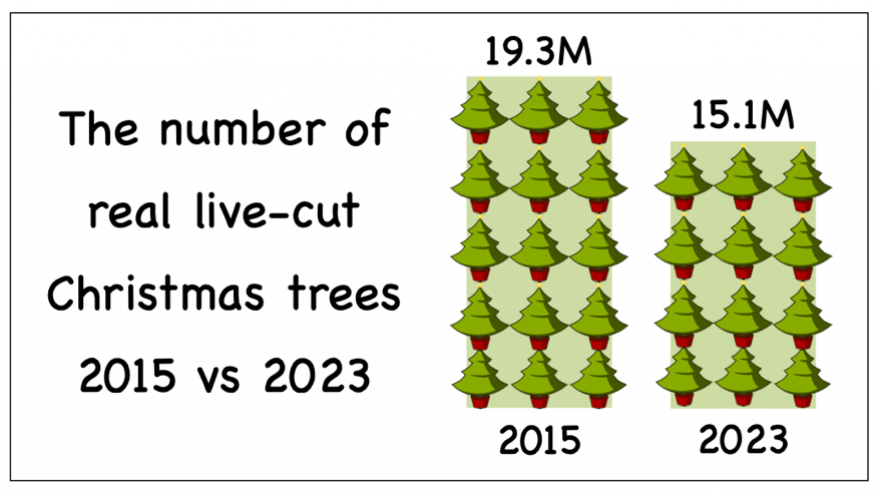
The number of real live-cut Christmas trees sold in 2015 was 19.3 million, declining to 15.1 million in 2023.
Live-cut tree purchases have been on the decline slowly over the last 40-50 years, Real Christmas Tree Board Executive Director Marsha Gray says. "It's part art, part science, and part crystal ball," Gray said, noting it takes an average of seven years to grow a tree and sometimes upwards of 10-15 years. "You are trying to guess what's going to sell and how much can sell 10 years from now."
98% of real Christmas trees sold in the United States are grown on nearly 15,000 farms. Oregon produces the most Christmas trees, followed by North Carolina, Michigan, Pennsylvania, and Washington.
Many Christmas tree farmers start with a young tree that is already 4 years old having spent two years in a seedling nursery and then another two years in a transplant bed before arrival at the final destination, where it will grow into a Christmas tree that will grace someone's home or business in the future.
Trees are approximately 2 feet high when planted in their permanent home at a live-cut tree farm. It takes at least another seven years for them to be ready for commercial sale, depending on consumer preferences for height.
With the growing attention on climate change, when trees' cooling and oxygenating properties have never been more valued, it seems counterintuitive to support chopping them down. Yet, the ecological benefits of real Christmas trees are why many environmentalists endorse them over the fake, petroleum-based versions shipped from half a world away, mainly from China.
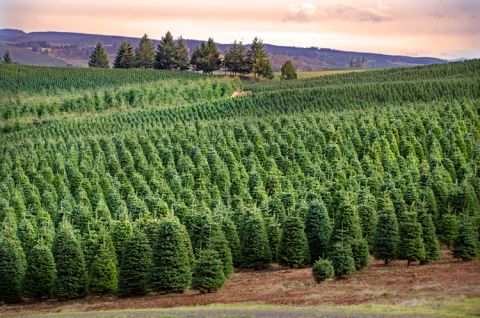
Christmas tree farms are wildlife habitats. When the trees are younger, they most resemble a meadow with a variety of foods for wildlife, such as grasses, weeds, and sometimes fruit-bearing shrubs and vines - raspberries, blackberries, and grapes. During the warmer season, this becomes home to an assortment of insects, which, in turn, attract small mammals and birds.
In the spring, deer give birth to fawns and tuck them beneath the shelter of conifers. They enjoy the relatively thick cover of young fir trees and the ability to see approaching predators down grassy open lanes.
By mid-late summer, it's common for Christmas tree growers to mow the grassy aisles between rows, giving opportunists like foxes, coyotes, and other mammals a chance to prey on rodents that are suddenly exposed without cover
Nesting songbirds: song sparrows, cedar waxwings, robins, and mourning doves all prefer to build nests close to the ground, making Christmas tree farms ideal.
Since most large Christmas tree farms plant in rotational stages, there are successional habitats, always offering habitats for wildlife that prefer all the different growth stages of the trees.
Subscribe to Agritourism Today (www.whitehutchinson.com/ subscribe/ agrinews/ )
[ Index of Previous eNewsletters (www.whitehutchinson.com/ news/ agrinews/ previous.shtml) ]
© 1999 - 2026, White Hutchinson Leisure & Learning Group, Inc.
The contents of this website and eNewsletters are protected by USA and international copyright law. Permission is granted to download and print single copites of any of the contents or articles for personal use. No other copies may be made. Educational institutions may obtain permission to make multiple copies for classroom use by e-mailing us with details. The contents of articles may be quoted provided credit is given to the "(author's name), White Hutchinson Leisure & Learning Group, Kansas City, MO, USA". All other rights for use or reproduction of the contents and articles are reserved.